
-
The Case for Comics

Written by Sophia Turean, a writer.
What’s the first thing that comes to mind when you think of comics? Childish drawings, cheap gags, and maybe some crass humor. You probably don’t think “educational.” I would like to make a case for comics to be seen as educational and used as such, starting with my favorite, xkcd by Randall Munroe.
xkcd promises to be “a webcomic of romance, sarcasm, math, and language,” and is all that and so much more. While some of Munroe’s comics are just silly, others have helped me understand larger concepts, such as the difference between precision and accuracy. These words are often used interchangeably in colloquial English, but they have different meanings. According to the Merriam-Webster Dictionary, “accuracy describes a particular measurement—that is, how close it is to the truth. But precision describes a measurement system—that is, how good it is at giving the same result every time it measures the same thing.” Confusingly enough, however, this same page lists accuracy as a synonym for precision. Acting as a counterpoint to this lengthy and contradictory description is the comic “Precision vs. Accuracy,” which wonderfully depicts, in words understandable to a layperson, the difference:
“Precision vs. Accuracy” by Randall Munroe, available under a Creative Commons Attribution-NonCommercial 2.5 License at https://xkcd.com/2696/. See https://xkcd.com/license.html. The comic’s humor only adds to its educational value. As a research paper on the effect of humor on memory found, “[h]umour has an additional benefit of having a positive effect on memory” (Tunku Badli and Dzulkifli). In other words, laughter, often lacking from classroom instruction, can actually help students retain information and recall what it is that they have learned.
Another instructional comic is The Illustrated Guide to Law, by lawyer and cartoonist Nathaniel Burney. Aimed at high schoolers and with a multitude of pages on criminal law, criminal procedure, constitutional law, and terrorism, this comic serves to make the legal system more accessible to the general public. For example, as stated concisely in this comic, merely staying silent after being read your Miranda rights is not enough; you must clearly invoke the right to remain silent. Evidently, webcomics, being both quickly accessible online and far easier to understand than wordy websites or books, provide an important way for people to inform themselves.
This value is not limited to webcomics, as is evident from the experience of Henry M. Gunn High School teacher Terence Kitada, who created an English class called The Art of Visual Storytelling, in which all the texts are graphic novels. The elective course became a reality after Kitada noticed that some students were having trouble finding meaning in traditional, text-filled novels and decided to bring his passion for comics and teaching together. Kitada is not the only teacher who feels this way. In fact, at least one graphic novel—They Called Us Enemy by George Takei—is now required reading in all Palo Alto Unified School District middle schools.
Even outside the English classroom, comics can be incredibly helpful. Kitada recalled his Advanced Placement Biology teacher, who would draw cartoons on the board to enhance the learning experience. He can envision “a whole textbook done in visual storytelling,” which prompted the idea that students would understand their textbooks if there were more pictures and diagrams and fewer confusingly worded sentences.
In short, comics are not lowbrow, trashy pictures. They are not a waste of time. Comics provide everyone with accessibility to a plethora of information. Comics are a great approach to education. So I invite you, find a comic or graphic novel. Read it. Enjoy it. See what you learn.
-
Silicon Valley

Reviewed by Kabir Mahajan, a writer.

Photo by Zetong Li on Pexels.com When Silicon Valley first aired in 2014, the tech culture we know today wasn’t as oppressively colossal—Elon Musk wasn’t at the edge of space, Jeff Bezos didn’t have a monopoly on, let’s face it, virtually everything, and Bill Gates was still the richest man in the world. Over its five-year run, Silicon Valley satirized the growing tech culture, poking fun at the foibles of the tech community.
The heart of the show is a group of friends—there’s awkward, idealistic coder Richard Hendricks (Thomas Middleditch), deadpan Satanist Bertram Gilfoyle (Martin Starr), arrogant entrepreneur Erlich Bachman (Todd Joseph Miller), anxious programmer Dinesh Chugtai (Kumail Nanjiani), and loyal business developer Jared Dunn (Zachary Woods). They live in an incubator run by Erlich, who provides them with free rent and utilities in return for a 10% share in their companies. (Erlich, in his usual patronizing manner, refers to them as his “incubees.”)
The show takes off when Richard invents a revolutionary lossless compression algorithm while trying to code a music copyright recognition app—a technique that can substantially reduce file sizes, and nearly instantaneously. He starts the company Pied Piper in the hopes of making this technology accessible to everyone, bringing on board his fellow “incubees.” The tech, however, turns out to be just the start of the struggle to achieve success: As the team races to secure funding and prepare a product, they must navigate the complex world of venture capital, going toe-to-toe with rivals in the tech industry (including Gavin Belson (Matthew Ross), chief executive officer of fictional tech corporation Hooli). Through the team’s ever-oscillating progress—there are pitfalls, followed by high jumps, followed by more pitfalls—it grows and shrinks, but manages to stay together.
The show wastes no time in providing commentary on Silicon Valley, highlighting the crippling self-doubt mixed with savior complexes characteristic of many tech giants: “I don’t know about you people, but I don’t want to live in a world where someone else makes the world a better place better than we do,” Gavin Belson tells his employees. Each episode ridicules the idiosyncrasies of tech culture, such as the tabs versus spaces argument between coders (spaces take a long time to type, but are standardized, whereas tabs are easy to tap, but may change on others’ computers). These critiques have become increasingly relevant, as it seems the tech culture has itself become the satire—Elon Musk walking into Twitter with a sink seems rather Belson-esque, after all. A court case in the sixth season, which came out in 2018, also mirrored Mark Zuckerberg’s testimony earlier that year.
While Silicon Valley certainly captures some aspects of the tech world well, others are handled unwisely. The lack of female characters present in the show looms large, especially in season one. It is pushed under the pretense of holding a mirror to the industry, but does little more than carry this culture on. It presents clichéd, lewd humor, along the lines of that in The Big Bang Theory. When the show does try to address the issue of sexism, it fails miserably—Monica Hall (Amanda Crew) says at one point, “Normally the tech world is 2% female. For the next three days? 15%,” as they enter a conference. Though this may seem fairly cutting, it’s one of the rare times the show actually acknowledges the absence of female characters.
The racial stereotypes present in the show are also noticeable. Part of the group’s dynamic is playful teasing—one-liners that have some oomph to them. In both Dinesh and Gilfoyle’s friendship, and in Erlich and new incubator resident Jian-Yang’s (Jimmy O. Yang) reluctant partnership, the racial undercurrent of many insults just serves to perpetuate harmful stereotypes, especially about Asians in tech. The show allows white characters to branch out, with caricatures ranging from dense fools like Big Head (Josh Brener) to tortured artists like Richard to Satanists like Gilfoyle—however, it keeps Asian characters in a relatively small box, particularly in Jian-Yang’s case. The irreverence of the show is what makes it entertaining, but things like Jian-Yang’s accent are used so often as humor devices that it’s hard to justify them.
In spite of these flaws, Silicon Valley is witty, hilarious, thrilling, and entertaining. All in all, the show is a good comedy, and definitely worth watching.
Silicon Valley is available for streaming on HBO Max, Spectrum TV, Prime Video, Vudu, and Apple TV. Rated TV-MA.
-
Zareen’s: Palo Alto Location

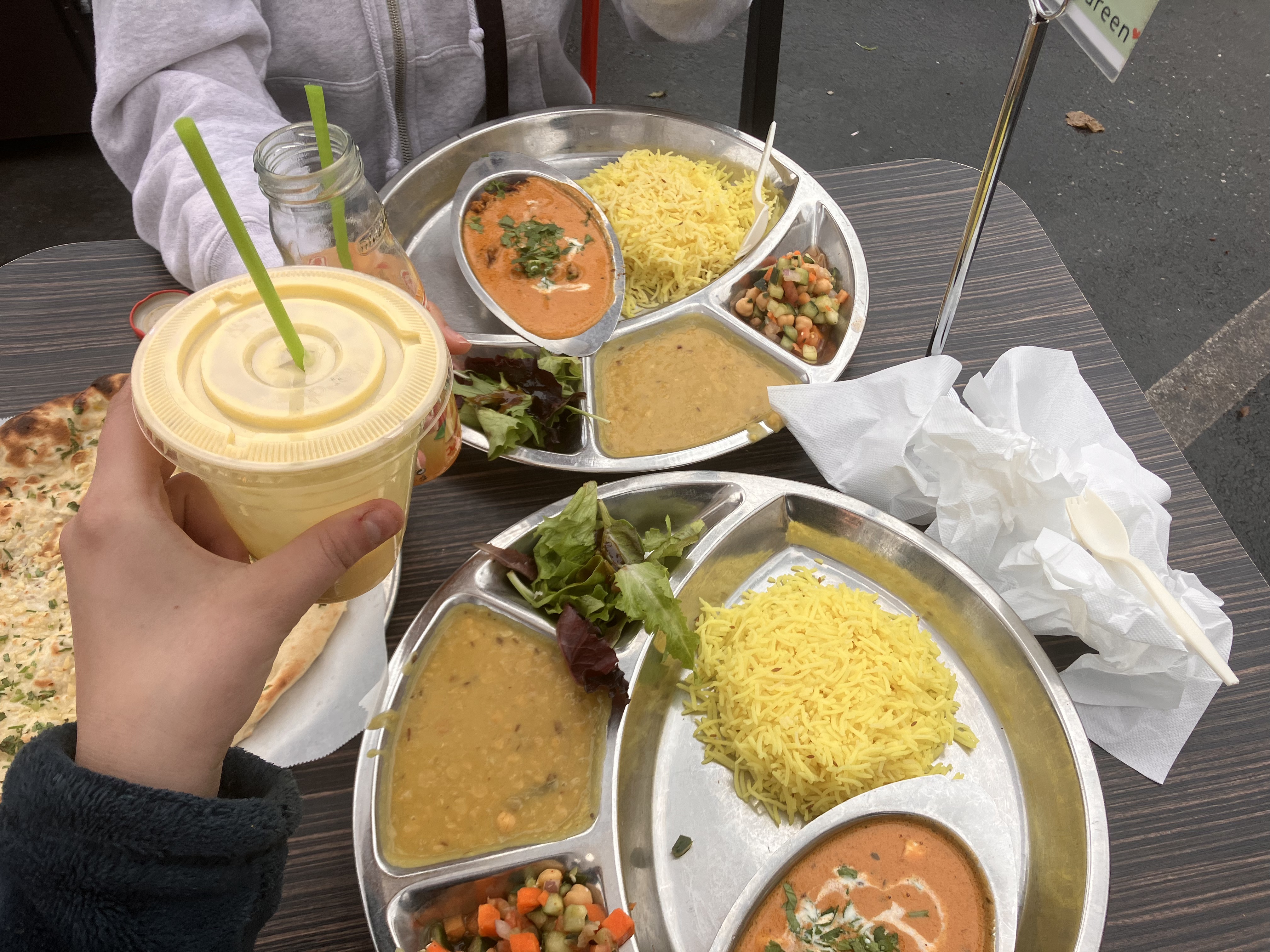
Zareen’s paneer tikka masala thali, which includes paneer tikka masala, rice, daal, and salad. Photo by Caitlin Ginn. Reviewed by Caitlin Ginn, a writer.
Zareen’s, located on California Avenue in Palo Alto, California, serves Indian and Pakistani cuisine along with a small selection of fusion dishes, such as tandoori burgers and naan wraps. The restaurant offers a variety of main dishes, including curries, kababs, and daals, as well as combination plates (thalis) consisting of a main dish with rice, daal, and a small salad. There are also smaller items, such as their samosas and wraps.
A fairly small restaurant with minimal inside seating and some outdoor seating, Zareen’s is very casual. It’s a favorite among college students because of the relaxed atmosphere and fairly inexpensive food. You wait in line to order next to a long counter where you can watch prep work being done. After ordering off of the extensive menu, you can choose a table, either inside surrounded by books, art, and the small talk of the surrounding tables, or outside, on larger tables outside fitted with colorful umbrellas and offering views of people walking their dogs and the everyday life of California Avenue.
I ordered the paneer tikka masala thali, the dish recommended to me by the waiter as one of Zareen’s number-one sellers, and it was delicious. The firm cheese was served in a rich, creamy, spice-filled, tomato-based sauce topped with fresh cilantro for color. As I’d ordered the thali, a combination plate, the paneer was accompanied by bright yellow daal made from lentils, turmeric, and chilies, along with a small salad on the side made of spring mix to add some brightness to the meal. The daal was incredibly flavorful, filled with turmeric—notable for its vivid color—as well as cumin, dried chilies, and more. The rice served with the plates was also seasoned well with saffron, salt, and whole cumin seeds. I ordered garlic naan to go with my dish, and it came out piping hot, covered in freshly sliced garlic and baked to perfection.
Not only were the dishes tasty, they were also beautiful. Each plate had so many different colors and textures on it that it resembled a piece of art. On my thali, there was the orange of the paneer tikka masala, the yellow of the daal, the green of the salad, the yellow of the rice, and the golden brown of the naan. Together, they made a plate that I couldn’t help but dig into immediately.
The balance of the flavors and the slight acidity in the tikka masala sauce is what really sets this restaurant’s food apart from that of others. The different flavors, textures, and elements of all of the menu items work perfectly together. In all honesty, I haven’t tried a combination of two of Zareen’s dishes that I have not loved. The dishes have roots in Indian and Pakistani cuisine, and the chefs mix different elements together to create their own take on the cuisines. All of their food I have ever had the pleasure of tasting has left me eager to plan my next trip to the restaurant.

Zareen’s garlic naan, which acts as a perfect complement to the paneer tikka masala. Photo by Caitlin Ginn. The ambience of the restaurant is a little confusing at first, but the different aspects work together, in a way. The dim interior lends itself to a somewhat romantic and private feel at the double tables nestled closely inside; however, the room is also full of families, college students, and everyone else imaginable filling the air with the sounds of their conversations. Outside, there is even more seating, but it is much more casual. This is not to say that inside is formal by any means— the furthest thing from it, in fact—but outside, people are seated on mismatched tables of varying sizes on metal chairs and crammed under umbrellas and tarps with space heaters in between.
The service at Zareen’s is nearly perfect, especially when you take into account the sheer number of people that they are serving, taking orders from, and keeping track of. All of the wait staff and kitchen staff are immensely kind and helpful, and the food gets delivered quickly. I will say, though, that in order to get to the point where you can even order your food at the front desk, you need to wait in a line that can take up to an hour to get through.
A friend who joined me to review the food said something along the lines of, “I could eat this food every day of my life and not get sick of it. I’m not even joking.” To that end, I think it would be a crime to give this restaurant a review of anything less than five stars. The food is impeccable, the service is great, and it is fairly inexpensive. This is not to say that a meal at Zareen’s is cheap, but the food is much more affordable compared to other restaurants in Palo Alto. A full meal plus a drink and a side for two people didn’t even come out to 30 dollars after tax, and most things on the menu are under 10 dollars. Without a doubt, Zareen’s is the perfect option for anyone seeking a casual, hearty, affordable meal in Palo Alto.
Zareen’s hours (Palo Alto location):
Monday through Friday: 11:30 a.m. to 11:59 p.m.
Saturday and Sunday: 11:00 a.m. to 11:59 p.m.
Located on 365 S. California Avenue, Palo Alto, CA. Other locations in Mountain View and Redwood City, CA. -
Glass Onion: A Knives Out Mystery
Reviewed by Amann Mahajan, Editor-in-Chief
An eccentric billionaire sends five seamless, polished wooden boxes to his five closest friends. After cracking a series of puzzles—peeling back the layers of the onion, so to speak—they receive an invitation to spend a weekend at his ritzy private island, where they will solve the mystery of his murder.
So begins Glass Onion: A Knives Out Mystery the sequel to Knives Out (2019), which retains its predecessor’s charm and cheeky self-awareness while showcasing a clear (albeit more exuberant) voice of its own. Though it’s perhaps not as subtle in its messaging as Rian Johnson’s first Benoit Blanc mystery, it’s still a worthy follow-up, and well worth a watch.
Right off the bat, we’re introduced to colorful characters, just as in Knives Out. There’s fashion designer and erstwhile model Birdie Jay (Kate Hudson), scientist Lionel Toussaint (Leslie Odom Jr.), Twitch streamer and men’s rights champion Duke Cody (Dave Bautista), and seemingly straight-laced Connecticut governor Claire Debella (Kathryn Hahn). Different in many ways, they’re united by their friendship with billionaire Miles Bron (Edward Norton), co-founder and CEO of Alpha Industries—essentially the “Knives Out” universe’s equivalent of Elon Musk. All four receive a box inviting them to Miles’ private island, as does Alpha co-founder Cassandra “Andi” Brand (Janelle Monáe), who’s become estranged from the group after Miles cut her out of the company.
Into this motley crew steps Benoit Blanc (Daniel Craig), the kindhearted detective with an accent pulled from the deep South. Mysteriously, he’s received an invitation to the island as well, though Bron didn’t send one to him. Regarded with suspicion from a (supposedly) tight-knit group of friends, he begins to understand that there might be much more going on beneath the glossy exterior of the Glass Onion than meets the eye. Miles’ friends are all dependent on his financial support: “Every single one of you is holding on for dear life to Miles Bron’s golden titties,” Andi aptly (if somewhat crassly) puts it. This makes it ever so easy for Miles to manipulate them, shape them like clay—and it creates ample room for resentment. Corruption and cowardice run rampant; as the weekend progresses, tensions come to a head, and a well-executed reversal makes it abundantly clear that all is not as it seems.
Like “Knives Out,” “Glass Onion” provides its fair share of social commentary, exploring race, class, and privilege. Obviously, Bron serves as a placeholder for eccentric billionaires like Musk and Mark Zuckerberg—yet the beauty of the movie is that it highlights the façade these men present, the ways in which they play others for fools. As Blanc chides Miles for an idiotic plan, Birdie exclaims, “Oh, it’s so dumb, it’s brilliant!” Almost wrathful, Blanc shoots back: “No! It’s just dumb!” It’s Miles’ parading, his flamboyance, his enthusiasm, and—importantly—his privilege that allow him to masquerade as a genius. In a way, Miles’ façade is like the use of misdirection in a magic trick—keep everyone’s eyes on something, and they’ll miss the truth. And in a mystery, instances of misdirection, red herrings, are all too common.
The movie’s commentary hits closer to home in no small part because of the setting: The film takes place in the summer of 2020, right near the beginning of the pandemic. Johnson puts the setting to good use, giving us subtle clues about each of the characters from their reactions to the crisis, right down to how each individual deals with their mask. (While Lionel wears his properly, Claire’s keeps slipping down her nose, Duke doesn’t wear one, and Birdie utilizes a sort of golden grille which would, in all likelihood, be completely useless.) Each character fits well into the overall picture of the pandemic; each typifies someone in power, whether it be a social media influencer or a political figure.
Some of Johnson’s messaging is a little on-the-nose, à la Don’t Look Up—the parallels to real life are almost too spot-on, the characters almost caricatures. Also like Don’t Look Up, it’s tinged with rage and despair. While the law enforcement, to some degree, aided to unravel Harlan’s murder in Knives Out, the situation is bleaker here. Blanc has much less faith in the system at the end of Glass Onion. Yet, just as Marta Cabrera maintains his faith in the salvageable goodness of humanity, so too does another character in Glass Onion. Without giving too much away, it’s this character that gives the film its emotional core, preventing it from veering into the extremes of comedy and tragedy.
The film has its moments visually, as well. As in Knives Out, many clues are hidden in plain sight, and keen-eyed viewers can pick past the most dexterous of Johnson’s cinematographic maneuvers if they know what they’re looking for. The “Mona Lisa,” bought by Miles to bail out a sinking Louvre, is a visual mainstay of the film, and it sets up both the ending reversal and the final shot beautifully. (And that final shot is up there with that from Knives Out, though it’s maybe not quite as satisfying.)
Nathan Johnson’s music is also standout, with lush strings and delightfully twangy harpsichord. It’s unique, but it remains grounded in the “whodunit” genre. Two themes in particular stand out: the main theme, sweeping and grand and just slightly tinged with darkness, and “Andi’s Theme,” a darker, more somber piece whose opening arpeggios are reminiscent of Beethoven’s Moonlight Sonata. As in any film, the music provides subtle hints about characters and events, and for those looking to unravel the mystery before Blanc, paying attention to musical cues could pay rich dividends.
Last but not least, the performances, like those in Knives Out, are also memorable. Monáe, especially, stands out, shining in a role that takes fortitude to play. Craig brings Blanc’s kindness, intelligence, and figurative language back (the donut hole in Knives Out becomes the heart of the onion in Glass Onion), while adding a little more goofiness into the mix—indeed, the first scene opens with him sitting in the bathtub, playing Among Us with friends from work. The performances are a little more exuberant, a little more over-the-top, than those in Knives Out, but so is everything else in the movie, from the score to the colors to the cinematography. Everything is bigger, wider, more sweeping, and that’s intentional, according to a Wired interview with Johnson: “It’s an honest reflection of what it feels like to be alive right now and paying attention to these people. It needs to be ridiculous because they are ridiculous, you know?”
Ridiculous or not, Glass Onion is, undoubtedly, entertaining—and really, isn’t that the point? Settle down with a bowl of popcorn and buckle up. It’s going to be quite a ride.
Rated PG-13.

 Zenith Review Magazine